
What Pleases Durga
My award-winning story on killing a goat in Nepal

An earlier draft of this story won Silver in the Travel Memoir Category at the 2026 Solas Awards for Best Travel Writing.
When I make it to the top, there are goats everywhere. Hundreds of goats. Scared, bleating goats, sensing death is near, stand on blue plastic tarps. Billy goats run at full speed toward their neighbors and are jerked back by ropes staked in the ground. Men carry goats with their legs tied together over their shoulders. No roads, paved or otherwise, come up this mountain.
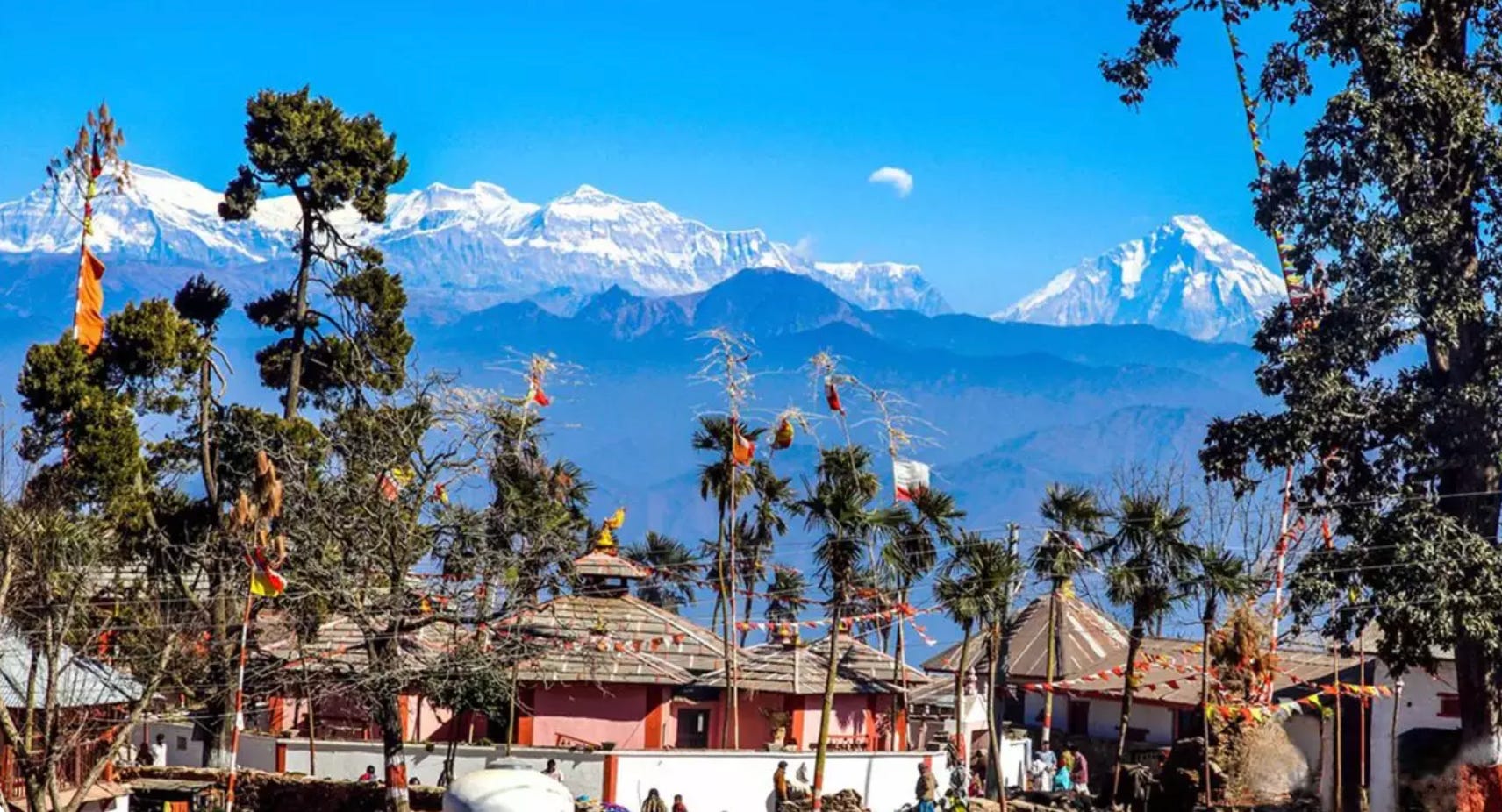
In the middle of the hilltop sits Swargadwari temple, or the “Gateway to Heaven,” a 100-year-old pilgrimage site in Pyuthan, Nepal built to honor a local cow herder. Next to the temple, smeared with red paint and covered in marigolds, is a shrine to the Hindu warrior goddess Durga, known for destroying demons disguised as water buffaloes. Durga is often depicted astride a lion with each finger as a different weapon.
Families dressed in their finest kurtas and daura suruwals gather around campfires, laughing and dancing, foreheads dotted with red tika, a mixture of uncooked rice, yogurt, and vermilion powder meant to give them good fortune. Hundreds of sacred resident cows wander around in the crowd, snatching fruit off picnic spreads. Reliant on local food donations, the cows have recovered from the Nepali Civil War when hundreds of them risked starvation.
The chaos is startling after hiking for ten hours in the dark. I’d arrived in Pyuthan District earlier that day, nauseous from a teeth-rattling ride from the capital. Watching the Peace Corps jeep disappear in a cloud of red dust, I’d resisted the urge to run after it screaming, “don’t leave me here.” Didn’t they know I don’t belong out here in mountains? Three months of training won’t get me far living with strangers.
I’d applied to the Peace Corps at twenty-five, submitting the application from my work computer as Excel formulas danced across the backs of my eyelids. I yearned to be free of my cubicle and go somewhere else, anywhere else. When the Peace Corps sent me an official assignment for Nepal, I’d scoured a world map and found the country, roughly the size of Tennessee, smashed between India and China.
Halfway into the hike, I’d asked my new host brother Prakash where we were going. He’s home from his construction job in Dubai to celebrate Dashain, a 15-day religious festival for Nepali Hindus. Today is the festival’s 8th day, when goats are sacrificed to Durga, cheaper substitutes for water buffaloes. “Not far,” he’d said. Since time and distance are abstract concepts in Nepal, I figured the actual distance could vary. I did not expect to hike all night. Despite the belt buckle he’s wearing emblazoned with the word “BITCH” in all caps, I trust Prakash’s friendly face. But he did tell me that I didn’t need a headlamp or a jacket before we started hiking for hours up this mountain in the dark. In his defense, he’s hiking in a t-shirt, and also said a bunch of other words I didn’t understand.
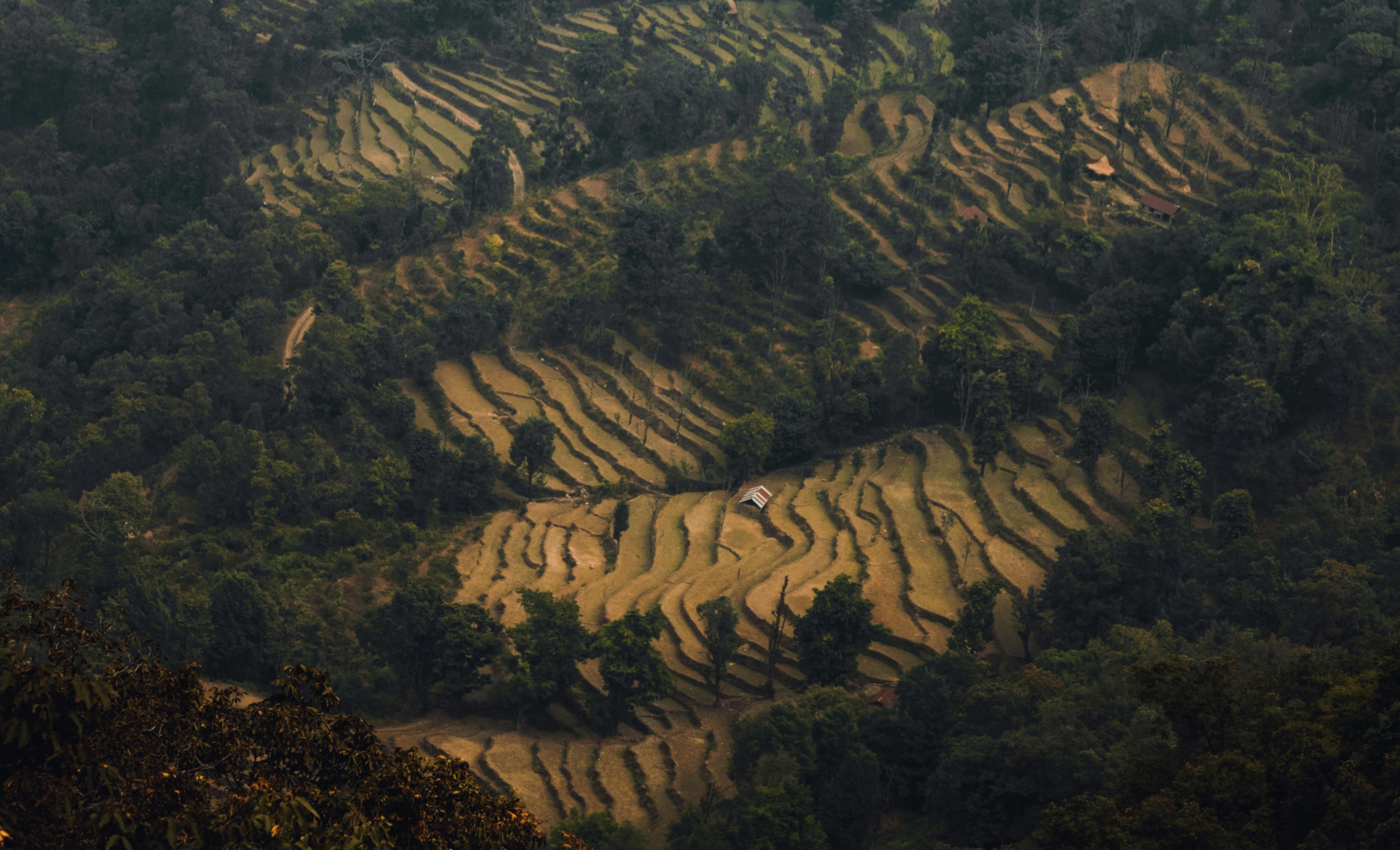
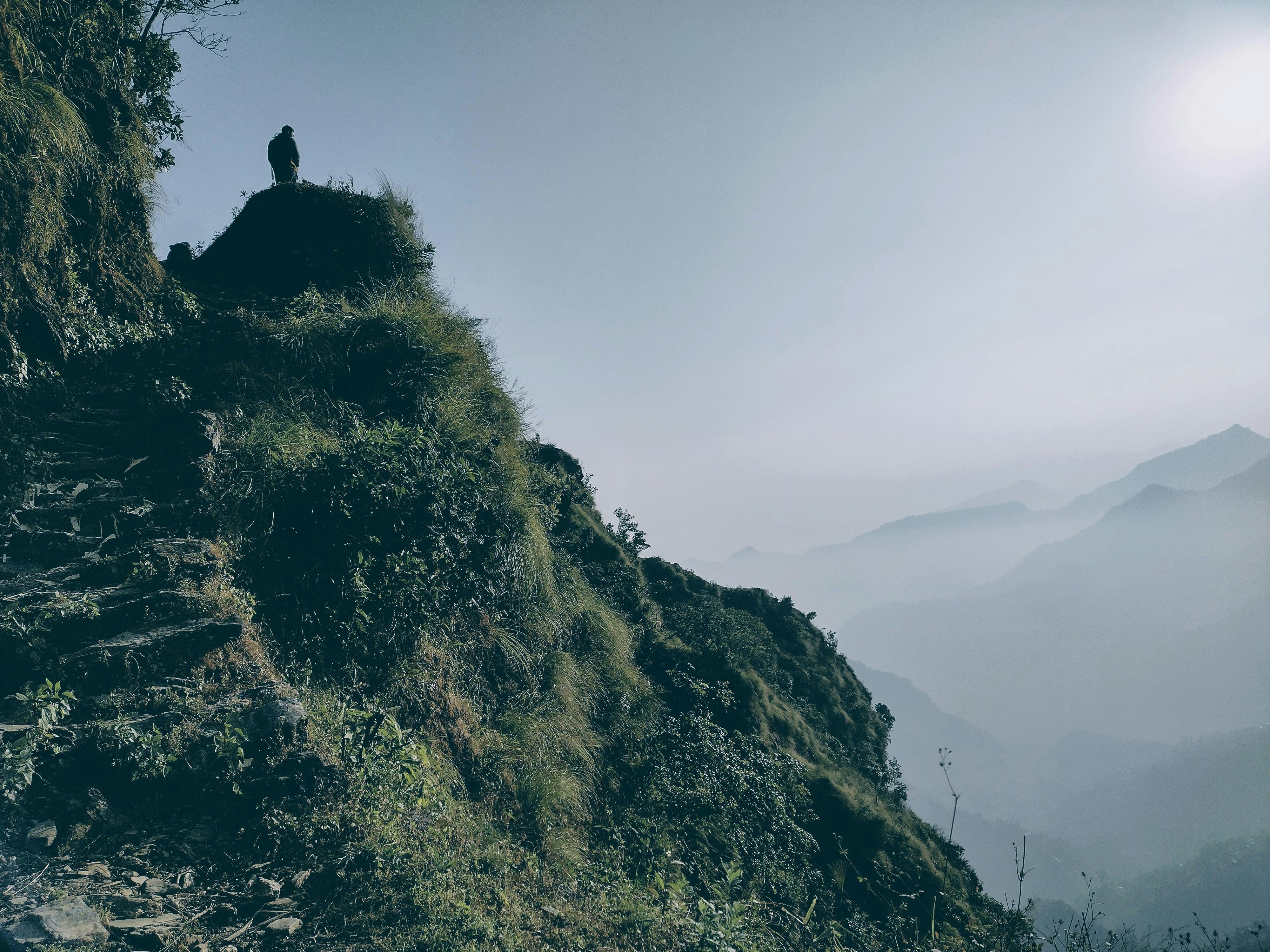
We trudged across rice paddies and rivers and through woods with puffed-up trees that looked like children’s book sketches. I enjoyed the beauty even as I struggled to feel my face. Prakash led our jaunt, with me at the back hiking at the speed of a toddler. To get over the final ridge to the temple, he came up behind me, put his hands on my back, and shoved me up the hill.
Looking around this dark hilltop, I wonder what I’m doing here. Three months ago, my experience with livestock consisted of buying chicken breasts wrapped in plastic at the supermarket. I’d never hiked or seen a real mountain before coming to Nepal. Thirty minutes on the stair climber was the closest I got to hiking. I’d seen a dead goat once pre-Nepal, when my high school friend’s uncle butchered and spit-roasted one on their Southside Chicago lawn for Greek Easter.
The crowd quiets. The goats get quieter too. We’ve reached some pre-agreed upon time everyone knows except me. Prakash removes the stake holding our billy goat to the ground, ties the goat’s ankles together with a rope, and grabs his machete. Neighbors surge over to hold the goat down and Prakash takes the first whack. The goat makes a gurgling sound and musk creeps through the air. I stop breathing in through my nose.
Prakash pauses and beckons me over. He hands me the machete and shows me how to hold it with a grip that’s firm but not so tight I can’t swing my wrist, pins the goat to the ground, points to the narrowest part of the goat’s neck, and says it’s my turn. This is a joke, I think. I can’t do this. He’s joking. I expected to spend my first evening in Pyuthan settling into my room, not becoming a goat executioner.
But I want to be part of this new family. I’ve gotten by in Nepal so far by eating everything I’m given and dancing on command. Goat killing can’t be much different, I lie to myself. Surely, Prakash will take the machete back if I hit the goat just once. I grip the machete with cold fingers. I glance down at my shaking hands with puzzlement; these are someone else’s hands. I block out the sound of goats dying all around me, and breathe in through my mouth, out through my mouth. Our goat squirms as Prakash struggles to hold it down. I look at the goat’s neck and not at the blood sliding down the blue tarp underneath it.
I take a whack.
“Too gentle,” Prakash tells me. “Hit it harder.” He doesn’t reach over to take the machete back. Our neighbors are killing their goats with a hit or two. I breath in again and take another whack. Still too gentle. The sides of my vision are edged with black, and all I see is the goat’s neck, blood seeping from the ragged neck wound. The quicker I do this, the quicker it will be over. It takes me two more hits to decapitate the goat.
“It’s dead now,” says Prakash. He holds my right arm steady and takes back the machete. He grabs the dead goat by the rope around its legs and hangs it upside down, neck lolling, to drain the blood over a plastic bowl. Adrenaline roars through my body. I could hike up this mountain all over again. My vision expands and I see people in the crowd shaking their phones in the air as they dance around campfires.
I don’t belong here yet. But someday I might.
Welcome to An Adventurous Life, I’m Julia Atkinson. I write travel stories and interview adventurers. I wrote about road tripping 4,000 miles solo across the United States for Business Insider and about National Park Cities for Trails Magazine.
Shoot me a note if there’s a topic you’d like to learn more about!
Until my next adventure,
Julia
Fantastic story. Thank you for sharing, Julia! I'm not sure what I would do, but these moments—everyday for some and so completely foreign to us—form the most vivid travel memories.
This is such a classic Peace Corps story!